The I-4 Dead Zone: What’s Documented, What’s Legend, and Why Drivers Still Talk About It
 sinisterplaces
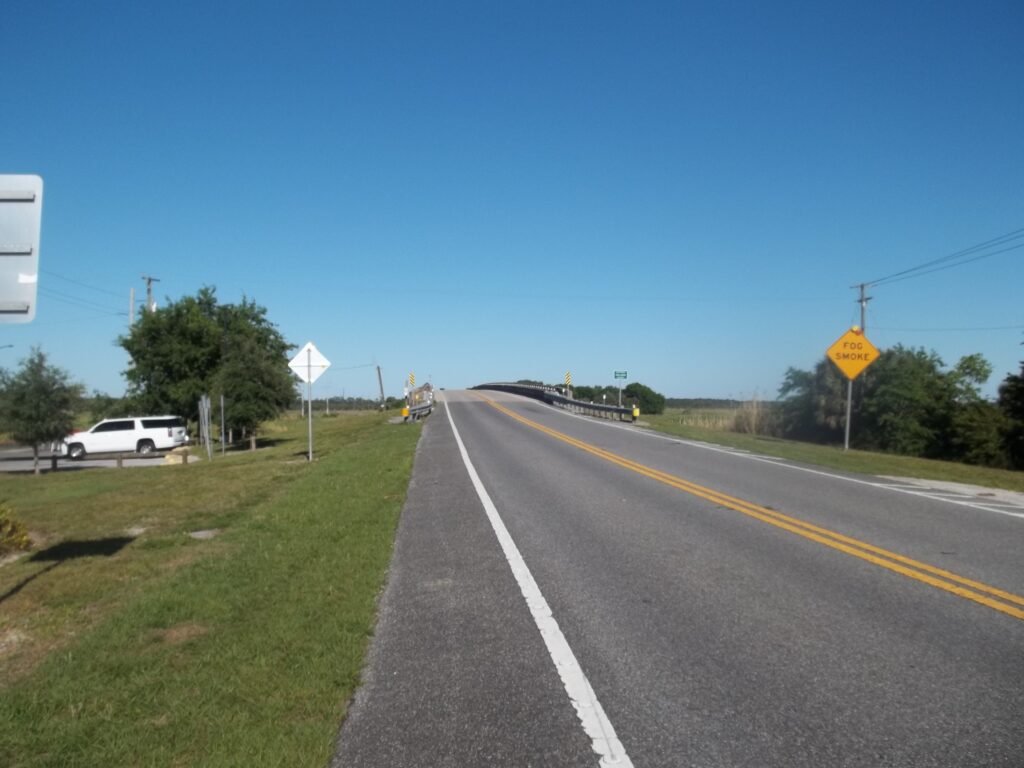
The State Road 46 bridge over the St. Johns River, near Sanford. Photo by Ebyabe, via Wikimedia Commons, <a href="https://commons.wikimedia.org/wiki/File:FL_St_Johns_River_Bridge_SR_46_east01.jpg">CC BY-SA 4.0</a>. This is a public river crossing close to the setting of the I-4 Dead Zone story, not a photograph of the graves or of I-4 itself.
Disclosure: As an Amazon Associate I earn from qualifying purchases. Bookshop.org and GhostStop links, where they still appear as placeholders, are not live referrals until those programs are approved. See our Affiliate Disclosure.
If you drive Interstate 4 this Thanksgiving week, you will pass a short stretch of pavement that Central Florida has been telling stories about for decades. Historian and Weird Florida author Charlie Carlson calls it “the Dead Zone”: a quarter-mile of I-4 near the St. Johns River bridge in Sanford, a highway he says was built on top of four unmarked graves.
Thanksgiving 2026 falls on Thursday, November 26. A lot of Tampa Bay and Orlando traffic will be on that road. This is the sourced version of the story — what Carlson and local news have actually said, what remains folklore, and why the only sensible advice is to keep driving.
Where the story is set
In an October 27, 2023 feature, ClickOrlando / WKMG News 6 described the Dead Zone as a quarter-mile stretch along the southern part of the I-4 bridge over the St. Johns River in Sanford. The station was writing about an RV Trader list of “haunted roads,” which had included this section of I-4. Lists like that are entertainment rankings, not official safety designations. The underlying legend is older than the list.
Carlson is a Sanford-born historian. Almost every specific claim below is his, as reported by News 6 or as he has told the story in Weird Florida. Where we repeat a haunting, a crash, or a cell-signal claim, we are repeating what he and others have said, not confirming a supernatural cause.
What’s documented in the telling: four burials, no last rites
As Carlson tells it, the story starts in the late 1800s. Henry Sanford, heading the Florida Land and Colonization Company, planned a Roman Catholic community called Saint Joseph’s Colony. An outbreak of yellow fever, Carlson says, killed four German immigrants in the colony. The only priest was away in Tampa — and later died of yellow fever himself — so the four were buried in the woods without last rites.
News 6 investigator Mike Holfeld, in the same 2023 report, stated the burial as “two adults and two children” on that spot. Those were real deaths, and two of them, in this telling, were children. That is not a hook. It is a reason to tell the story carefully and not to treat the place like a playground.
Historic maps of Saint Joseph’s Colony and the Orange Belt Railway have been used to illustrate the setting; News 6 credited the Sanford Museum for those maps. We have not independently reconstructed the grave locations from survey records for this article. The precise plot is part of Carlson’s account, not something we have marked on a public map, and we are not going to.
The land changes hands — and a marker is moved
According to Carlson’s book, as summarized by News 6, the land was later bought by Albert Hawkins — Carlson’s grandfather — in 1905. The names on the burial plot had already been lost. Hawkins, the story goes, warned other farmers not to tamper with the graves, then removed a nearly rotted wooden marker himself. His house burned down.
That sequence is family history as Carlson tells it. A house fire after a marker was moved is the kind of coincidence folklore loves. It is also the kind of event that can have an ordinary explanation. We are not in a position to prove a connection, and Carlson’s own role as both historian and grandson is worth keeping in mind: he is a primary source for this part of the story, not a detached state archive.
1960: flagged for removal, then buried under the road
Decades later, Carlson says, the state acquired the land to build Interstate 4. In his account, when I-4 came through in 1960 the graves were “roped off and marked for removal,” but they were never moved. “Instead, they dumped fill dirt on top to elevate the new highway.” His summary to News 6 was blunt: “They are still there.”
If that construction account is right, four people remain under a modern interstate. That is a somber fact of road building, whether or not anything uncanny followed. We have not located a separate Florida Department of Transportation statement for this article that confirms or contradicts the “marked for removal” detail, so we leave it attributed to Carlson.
What people still report — and what we can and cannot check
Carlson and others have described a cluster of later claims around the same quarter-mile:
- On opening day of I-4, a tractor-trailer carrying frozen shrimp jackknifed “right above the graves,” in Carlson’s telling, as reported by News 6.
- The eye of Hurricane Donna (1960) is “supposedly” said to have passed directly over the same spot.
- Drivers and storytellers report orbs or “wispy balls of light,” roadside apparitions or hitchhikers, phantom trucks, radio static, and a dead cell signal in that short stretch.
- Carlson has also said there have been “more accidents per year in such a small quarter-mile section of highway than all the other sections of highway between Daytona and Tampa.” That is a very strong claim. We are repeating it as his claim. We have not independently verified it against official crash data for this article, and you should not treat it as a verified DOT statistic until someone does that work in the open.
Gillian Luce of Trader Interactive, speaking to News 6 about the RV Trader list, also mentioned audience stories about cell-service loss and electronics malfunctioning. Cell “dead zones” have ordinary causes — bridge structure, coverage maps, a dip in the terrain — and those causes can sit right next to a legend without proving it.
How to treat this road
Do not stop on I-4 to look for graves. Do not pull onto the shoulder, walk the right-of-way, or film from a travel lane. There is nothing in this story that is worth a crash, and two of the four burials in the standard telling were children. If you want to sit with the history, read the sources and, if you go to Sanford, do it in a legal, parked, ordinary way — a museum, a public lot, a conversation — not on the interstate itself.
For Thanksgiving traffic especially, the useful ending is the unromantic one: slow down, put the phone down, and get where you are going.
If you want the book this story is drawn from
Carlson’s Weird Florida is the main published source for the version of this legend that local television still quotes. Once our bookstore affiliates are approved, we will put a clean, disclosed link here. Until then, you can find the book through your library or any bookseller you already use.
If you want the book this story is drawn from, here is Carlson’s Weird Florida (2009 reprint):
As an Amazon Associate I earn from qualifying purchases.
Affiliate link placeholder — Bookshop.org: Add a tagged Bookshop.org link for Charlie Carlson’s Weird Florida after that program accepts the site.
Sources
- Anthony Talcott, “Do you drive ‘The Dead Zone’ in Central Florida? I-4 among most haunted roadways,” ClickOrlando / WKMG News 6, October 27, 2023, quoting Charlie Carlson and Mike Holfeld, with maps credited to the Sanford Museum.
- Charlie Carlson, Weird Florida, as cited in the News 6 report above.
Related: a legal ghost-tour kit (this is not a place to “investigate” from a car), and the Edwinola in Dade City for a Pasco County story you can look at from a public street.
Featured image credit: The State Road 46 bridge over the St. Johns River, near Sanford. Photo by Ebyabe, via Wikimedia Commons, CC BY-SA 4.0. This is a public river crossing close to the setting of the I-4 Dead Zone story, not a photograph of the graves or of I-4 itself.