The Don CeSar: Thomas Rowe, the White Suit, and the Legend That Probably Isn’t True
 sinisterplaces
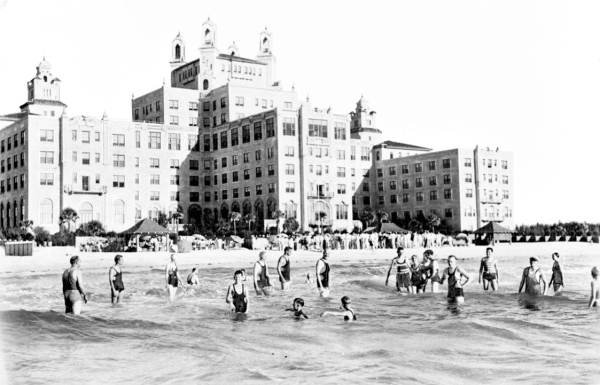
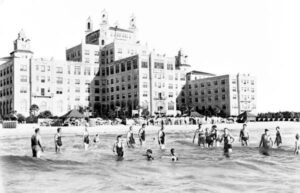
The Don CeSar on St. Pete Beach. Photograph from Florida Memory, public domain, via <a href="https://commons.wikimedia.org/wiki/File:Don_CeSar_Hotel-_St._Petersburg_Beach,_Florida_(8410317737).jpg">Wikimedia Commons</a>.
The Don CeSar rises off the sand at St. Pete Beach in a shade of pink you can see from a long way out in the Gulf. It opened in January 1928. Its builder, Thomas Rowe, died in 1940. For decades after that, staff and guests have described a white-haired man in a white suit and a Panama hat — Rowe’s usual outfit, in the telling — who appears in the lobby or along the sand and is gone when someone approaches.
That is the ghost story people come for. The more interesting part may be the love story that often arrives with it, because that part is probably a marketing invention.
What is solid
The hotel’s basic history is not in dispute. Rowe, an architect from New York, came to Florida in the mid-1920s and built the “Pink Palace” on St. Pete Beach; Historic Hotels and later press accounts put the opening in January 1928 and Rowe’s death in 1940. He named the hotel after Don César de Bazan, the hero of the opera Maritana. During World War II the building had a documented second life as an Army hospital and later government offices, then returned to hotel use. You can stand on the public beach or Gulf Boulevard and see the thing itself. That is enough architecture and enough history to justify a visit without a single apparition.
Rowe’s death is also not a mystery, but the exact last room is told two ways. Some popular write-ups say he collapsed and died in the lobby in 1940. Other accounts say he collapsed in the lobby, refused a hospital, and died a few days later in a sickbed in first-floor rooms. We are not going to pick a version we cannot source to a contemporary obituary here. He died in 1940, and the hotel went on. Several accounts say he died without a will and that the property passed to his wife, Mary Lucille, from whom he was estranged.
The man in the white suit
The recurring ghost report is consistent in its costume if not in its proof: a white-haired man, a white linen or tropical suit, a Panama hat, sometimes cigarette or cigar smoke, sometimes a greeting in the lobby, sometimes a walk on the sand or in the gardens. It is a legend the hotel has lived with for a long time, and it is a legend, not a finding. If you stay there, follow the hotel’s own rules for guests and photography. If you do not have a room, the exterior and the public beach are the legal view.
Lucinda, and a story that ate its own tail
The official-sounding romance goes like this: a young Thomas Rowe falls in love with a soprano named Lucinda, performing in Maritana in London; her parents take her away; she dies; he builds the pink hotel as a tribute, complete with a replica of the fountain where they used to meet; guests later see the couple walking together.
It is a tidy story, and it is very likely invented. In March 2008, Tampa Bay Times writer Lane DeGregory dug into it in a piece often cited as “Love’s Fate is Sealed.” As later summarized by Historic Hotels and by writers who followed her reporting, DeGregory found no record of a soprano named Lucinda in productions of Maritana. When she asked hotel concierges where they had gotten the tale, they pointed to the marketing department; marketing pointed to a ghost-book author; the author pointed back to a hotel PR contact. The story had gone in a circle and come home.
Rowe’s name on the opera is still interesting without the invented soprano. He really did name a Florida beach hotel after Don César de Bazan. That is already a strange, specific choice. It does not need a deathbed letter that cannot be found.
The better ending, if you like ghost stories, is the honest one: people still describe a man in a white suit in a pink hotel that has been on this beach since 1928. The love story you usually hear with him is probably an ad. That, more than a vanishing Panama hat, is the detail worth repeating.
Sources
- Historic Hotels and later press summaries of the hotel’s opening (January 1928), Rowe’s arrival in Florida, the Maritana name, and DeGregory’s reporting. See “The Don CeSar: Florida’s grand hotel has an intriguing history.”
- Lane DeGregory, Tampa Bay Times, March 2008, “Love’s Fate is Sealed,” as cited in the Historic Hotels discussion above (no Lucinda in the opera record; the tale traced back through marketing and a ghost book to hotel PR).
- Later overviews of the white-suit reports, including HauntedRooms’ Don CeSar page, which also flags the Lucinda story and the 2008 Times reporting. Ghost reports are treated here as reports.
Related: the Cuban Club in Ybor and the Edwinola.
Featured image credit: The Don CeSar on St. Pete Beach. Photograph from Florida Memory, public domain, via Wikimedia Commons.